
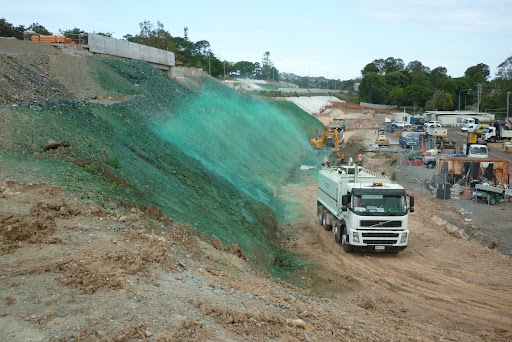
Every construction project begins by disturbing the ground. Whether it’s clearing vegetation, excavating for infrastructure or creating new batters, exposed soil immediately becomes vulnerable to wind, rainfall and surface water movement. Left unmanaged, those natural forces can quickly undo weeks of work, carrying valuable topsoil away from the site and transporting sediment into drainage systems, waterways and neighbouring properties.
For project managers, contractors and environmental consultants, erosion isn’t just an environmental box to tick. It can slow jobs down, add unplanned maintenance, invite regulator attention and create avoidable risks for crews and neighbours. The real challenge isn’t simply “stopping erosion” – it’s choosing a control strategy that fits the site you’re actually working on, can cope with changing weather and will keep performing for as long as the project needs it.
While traditional erosion control materials continue to play an important role, advances in polymer technology have expanded the options available to industry. Modern soil-binding polymers now provide practical, scalable solutions for stabilising exposed ground where vegetation cannot establish immediately or where conventional treatments may struggle to perform.
For these reasons, it’s important to understand how polymer-based erosion control works, where it delivers the greatest value and how it can be integrated into a broader erosion and sediment control strategy that supports both environmental compliance and long-term project performance.
Why Erosion Control Should Be Planned Before Earthworks Begin
The Cost of Waiting Until Erosion Becomes Visible
One of the most common mistakes on construction and infrastructure projects is treating erosion as something that can be addressed after it appears. In reality, by the time rills begin forming on a batter or sediment starts leaving a site, the underlying problem has already developed. Rainfall events can remove fine particles within hours, particularly from dispersive soils or recently graded surfaces. Once this occurs, the consequences often extend beyond replacing lost material. Contractors may need to repair damaged batters, reinstate sediment controls, clean drainage infrastructure or respond to environmental complaints, all while managing delays to construction activities.
Planning erosion control early allows stabilisation measures to be implemented before these risks develop. This approach aligns with the principles promoted by the International Erosion Control Association (IECA) Australasia which encourages preventing erosion at its source rather than relying solely on sediment capture downstream.
Every Site Behaves Differently
No two projects experience erosion in exactly the same way. The effectiveness of any erosion control system depends on a combination of factors:
- Soil classification and particle size
- Slope length and gradient
- Rainfall intensity and runoff patterns
- Wind exposure
- Construction staging
- Vehicle and machinery movements
- How long the surface will remain exposed
A solution that performs well on a subdivision batter may not provide adequate protection on a mine rehabilitation project or rail corridor. Successful erosion control begins with understanding how these variables interact before selecting the most appropriate materials.
Beyond Blankets and Mulch: How Erosion Control Has Evolved
Traditional Methods Still Have Their Place
For decades, erosion control relied heavily on physical protection systems such as coir matting, jute blankets, rock armouring and hydraulic mulch. These materials remain effective in many situations, particularly where vegetation can establish quickly or where slopes require immediate surface protection.
Hydromulch, for example, provides an excellent growing medium for seed establishment, while erosion control blankets protect freshly seeded batters from rainfall during early germination. However, traditional materials also have limitations. Installation can be laborious, some products deteriorate relatively quickly under harsh weather conditions, and many rely on vegetation becoming established before they achieve their full level of protection. For temporary construction areas, stockpiles or highly trafficked surfaces, additional stabilisation measures may be required.
Where Polymer Technology Fits
Rather than replacing traditional erosion control materials, polymer technology expands the range of solutions available to project teams. Polymer soil binders work differently from blankets or mulch. Instead of covering the soil surface, they bind fine particles together to increase cohesion and improve resistance to erosion caused by rainfall, wind and surface runoff. Once applied, the treatment forms a flexible, semi-permeable matrix that stabilises exposed soils while still allowing air and water to move through the surface. This distinction is important because it enables treated areas to remain biologically active while reducing the likelihood of soil displacement during construction.
In many projects, polymers are used alongside conventional erosion control solutions to provide a layered approach to site stabilisation rather than relying on a single product to perform every function.
Selecting Polymer Erosion Control for Different Site Conditions
Not Every Polymer Performs the Same
One of the biggest misconceptions surrounding polymer-based erosion control is that every product delivers the same result. In reality, formulations vary considerably depending on their intended application, durability and interaction with different soil types. Some polymer systems are designed primarily for temporary dust suppression, while others are engineered to provide medium or longer-term surface stabilisation across exposed construction areas. Certain formulations perform exceptionally well on fine-grained materials, whereas coarse aggregate or highly dispersive soils may require different application techniques or complementary stabilisation methods.
Selecting the appropriate product should therefore begin with understanding the conditions of the site rather than choosing a solution based solely on product specifications:
- Will the surface remain exposed for weeks or months?
- Is vegetation expected to establish during the stabilisation period?
- Will the area experience heavy vehicle traffic?
- How likely is significant rainfall before permanent rehabilitation begins?
- Is the treatment intended to reduce erosion, suppress dust or achieve both outcomes?
Answering these questions early allows project teams to specify erosion control systems that are better matched to operational requirements, reducing the likelihood of premature failure or unnecessary maintenance.
Understanding How Soil Type Influences Performance
Successful erosion control starts with understanding the material being stabilised.
Clay-rich soils generally respond differently to polymer treatments than sandy or gravelly materials. Fine soils often allow greater particle binding, while coarser materials may require increased application rates or alternative stabilisation strategies to achieve consistent surface cohesion.
Dispersive soils present another challenge. These soils naturally break apart when exposed to water, making them particularly susceptible to erosion. Polymer treatments can improve resistance to particle movement, but they are most effective when integrated into a broader erosion and sediment control strategy that manages runoff and drainage at the same time.
The interaction between polymer chemistry, soil composition and moisture conditions is one reason why experienced application contractors often undertake site assessments before determining treatment rates.
Polymer Treatments Work Best as Part of a Complete Erosion Control Strategy
Stabilising the Source Rather Than Managing the Consequences
One of the fundamental principles of modern erosion management is controlling soil movement where it begins. Historically, many construction projects invested heavily in downstream sediment capture through sediment basins, silt fences and inlet protection. While these controls remain essential, they are designed to manage sediment after erosion has already occurred.
Current best practice places greater emphasis on preventing soil particles from becoming mobile in the first place. Surface stabilisation plays an important role in achieving this objective by reducing the amount of loose material available for rainfall or wind to transport. When erosion is minimised at its source, sediment control devices operate more effectively and require less ongoing maintenance.
Rather than viewing polymer applications as a replacement for sediment controls, they should be considered another layer within a comprehensive environmental management strategy.
Combining Multiple Erosion Control Measures
The most successful projects rarely rely on a single erosion control product. Instead, different techniques are combined according to the risks presented across various parts of the site. For example:
- Steep batters may be protected using erosion control blankets while polymer treatments stabilise adjacent maintenance access tracks.
- Hydromulch can promote vegetation establishment on rehabilitation areas while polymer soil binders protect exposed stockpiles awaiting future works.
- Sediment basins continue capturing runoff while treated haul roads reduce the amount of material entering the drainage network.
This layered approach improves overall resilience, particularly during extended construction programs where site conditions continue evolving.
Where Polymer Erosion Control Delivers the Greatest Value
Temporary Exposure Doesn’t Always Mean Temporary Risk
Many construction areas remain exposed for only a few weeks before permanent works commence. However, that short period often coincides with the highest erosion risk.
Freshly graded batters, utility corridors, subdivision stages and infrastructure easements frequently experience rainfall before permanent landscaping or revegetation can occur.
During this window, significant soil movement can occur if surfaces remain untreated.
Polymer stabilisation provides an effective interim solution by protecting exposed ground until permanent rehabilitation measures are installed. This can reduce the likelihood of:
- Surface scour
- Loss of valuable topsoil
- Sediment entering waterways
- Repeat grading after rainfall
- Delays caused by environmental rectification works
Large-Scale Infrastructure Projects
Major infrastructure projects often involve extensive areas of exposed ground that cannot be rehabilitated immediately. Examples include:
- Highway upgrades
- Rail corridors
- Renewable energy developments
- Pipelines
- Industrial estates
- Mining and quarry rehabilitation
In these environments, hydraulic application methods allow large treatment areas to be covered efficiently, reducing the time exposed soils remain vulnerable to erosion.
Where project staging extends over several months, polymer systems can provide a practical method of maintaining surface stability while construction continues.
Common Mistakes That Reduce Erosion Control Performance
Even high-quality erosion control products can underperform if they are applied incorrectly or specified for unsuitable conditions. Some of the most common issues include:
Applying Products to Poorly Prepared Surfaces
Loose debris, standing water or unstable subgrades reduce product adhesion and can compromise long-term performance.
Ignoring Weather Forecasts
Heavy rainfall immediately after application may reduce effectiveness if sufficient curing time has not been allowed.
Selecting Products Based on Cost Alone
Lower-cost treatments often require more frequent reapplication, increasing labour and maintenance costs over the life of a project.
Treating Symptoms Rather Than Causes
Surface stabilisation should complement appropriate drainage design, runoff management and sediment control—not replace them.
Projects that address only visible erosion without considering water movement are more likely to experience recurring failures.
Looking Ahead: The Next Generation of Erosion Control
Performance, Sustainability and Compliance Are Driving Change
Environmental expectations continue to evolve across Australia’s construction, infrastructure and resource sectors. Regulators, developers and asset owners are increasingly looking beyond short-term erosion control measures towards systems that deliver measurable performance over the entire construction lifecycle. That shift is influencing the products specified on projects.
Instead of selecting erosion control materials solely on purchase price, project teams are increasingly considering:
- Whole-of-project maintenance costs
- Environmental performance
- Water consumption
- Installation efficiency
- Longevity under Australian conditions
- Compatibility with revegetation programs
Polymer technology continues to evolve in response to these expectations. Modern formulations are being designed to improve soil stability while supporting vegetation establishment, reducing maintenance requirements and minimising environmental impact.
Importantly, these products are no longer viewed as niche solutions. Across many civil construction, mining and rehabilitation projects, polymer-based stabilisation has become another practical tool within the erosion and sediment control toolbox.
Good Erosion Control Starts With Better Planning
One of the strongest themes emerging across the industry is that successful erosion control rarely comes down to selecting a single product. Projects that consistently achieve positive environmental outcomes typically share several characteristics:
- Erosion risks are assessed before earthworks commence
- Temporary and permanent stabilisation measures are planned together
- Products are selected based on site conditions rather than habit
- Surface stabilisation is integrated with drainage and sediment controls
- Performance is monitored and adapted as site conditions change
This proactive approach reduces rework, limits environmental risk and provides greater confidence that erosion control measures will continue performing throughout construction.
Rather than asking, “Which erosion control product should we use?”, many project teams are now asking a more valuable question: “What combination of treatments will provide the greatest level of protection for this particular site?”
That change in thinking often leads to more durable, more sustainable and more cost-effective outcomes.
Key Considerations When Selecting Polymer Erosion Control
Every project presents different challenges, but several principles apply across almost every construction or rehabilitation site. When evaluating polymer-based erosion control systems, consider:
Site Conditions
Assess soil classification, slope gradients, drainage patterns and anticipated weather exposure before selecting products.
Project Duration
Temporary construction staging requires different stabilisation strategies to long-term rehabilitation or permanent infrastructure works.
Environmental Objectives
Consider how erosion control integrates with broader environmental management plans, including sediment control, revegetation and water quality protection.
Maintenance Requirements
Evaluate not only installation costs but also expected maintenance, reapplication frequency and operational disruption throughout the project.
Compliance
Ensure selected materials and installation methods align with project specifications, environmental approvals and recognised industry guidance such as IECA Australasia’s Best Practice Erosion and Sediment Control principles.
Taking these factors into account early often delivers better technical outcomes while reducing project risk over time.
There is no universal erosion control product capable of solving every site challenge.
Successful erosion management relies on understanding how soil, water, weather and construction activities interact throughout a project. Polymer stabilisation has become an increasingly valuable option because it addresses one of the most important objectives of erosion management, preventing soil movement before it occurs.
Used appropriately and alongside complementary erosion and sediment control measures, polymer technologies can help reduce maintenance requirements, improve site stability and support environmental compliance across a broad range of construction, infrastructure, mining and rehabilitation projects.
As construction projects continue to grow in scale and environmental expectations become more demanding, selecting erosion control strategies based on performance rather than familiarity will become increasingly important.
How Balanced Solutions Can Help
Effective erosion control is rarely solved by a single product. Balanced Solutions works with contractors, developers, engineers and environmental teams to assess site conditions first, then apply the right combination of treatments across polymer soil stabilisation, hydromulching, revegetation, dust suppression and sediment control.
Across civil construction, infrastructure, mining and land rehabilitation, our role is to help project teams move from reactive fixes to planned, performance-led erosion management. By combining proven materials with practical field experience, Balanced Solutions develops site-specific strategies that reduce risk, support compliance and hold up under Australian conditions.
